What is the Best Window for African Violets? A Beginner’s Guide

You just brought home your very first African Violet. You admire its fuzzy leaves and vibrant blooms, but a familiar anxiety starts creeping in. You immediately wonder if you will accidentally kill this beautiful little houseplant. Take a deep breath and let go of that worry right now.
Successfully growing African Violets comes down to mastering one fundamental element: light. Lighting dictates how well your plant drinks, grows, and ultimately blooms. Give your plant the right amount of light, and it will reward you with near-constant flowers.
Professional growers know that finding the perfect spot solves almost every common indoor gardening problem before it begins. Let me walk through your home and find the exact window that will keep your new green friend thriving.
Why Lighting Makes or Breaks Your African Violet
In their natural habitat, African Violets grow under the shade of taller trees in tropical forests. They never experience harsh, direct sunlight beating down on their delicate foliage. Instead, they bask in bright, dappled light that filters through the canopy above.
You need to recreate this specific lighting environment inside your home. If you give the plant too little light, it will refuse to bloom and develop weak, leggy stems. If you blast it with too much direct sun, the leaves will scorch, turn yellow, and eventually die. The secret to success lies in finding the sweet spot: bright, indirect light.
How to Test Your Light (No Guesswork Required)
Beginners often panic because “bright, indirect light” sounds vague. You can test your light levels right now using two simple methods.
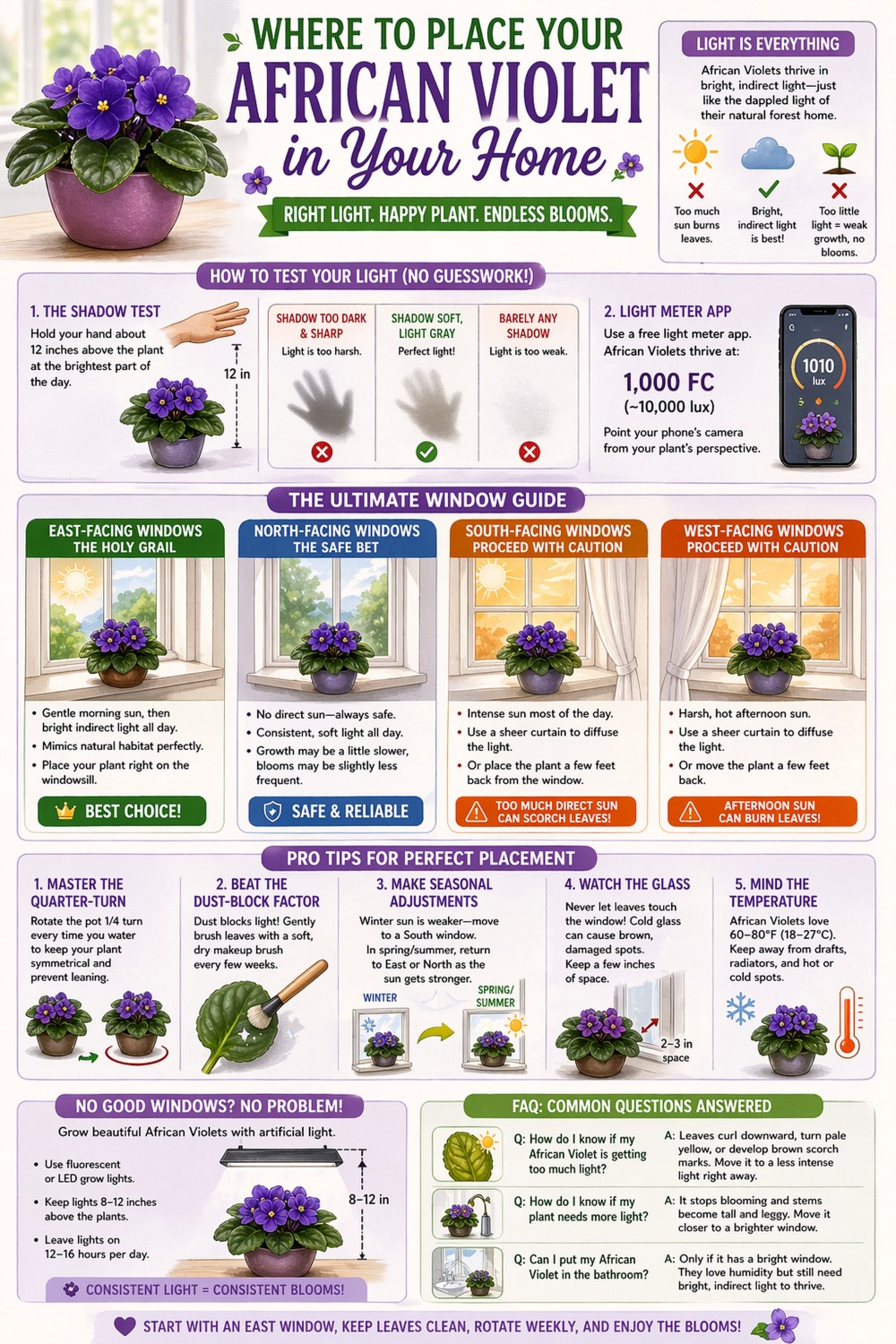
First, try the Shadow Test. Hold your hand about 12 inches above the plant during the brightest part of the day. If the shadow cast on the plant is sharply defined and dark, the light is too harsh. If you barely see a shadow, the light is too weak. The perfect light casts a soft, blurry, light-gray shadow.
If you prefer hard data over visual tests, download a free light meter app on your smartphone. African Violets thrive best when they receive around 1,000 foot-candles (FC) or roughly 10,000 lux. Point your phone’s camera at the light source from your plant’s perspective. Hitting these exact numbers removes all the guesswork and instantly relieves your anxiety.
The Ultimate Window Guide for African Violets
Walk around your home and identify the directions your windows face. Your choice of window will dictate your plant’s daily care routine. Here is exactly how each exposure affects your African Violet.
East-Facing Windows: The Holy Grail
If you have an East-facing window, you have found the absolute best spot for your new plant. East windows provide gentle, direct morning sun when temperatures are still cool. After the morning passes, the window offers bright, indirect light for the rest of the afternoon.
This exposure perfectly mimics the African Violet’s natural forest habitat. You can place your plant right on the windowsill without worrying about burning the leaves. If you want a foolproof location that practically guarantees success, choose the East window.
North-Facing Windows: The Safe Bet
North-facing windows serve as an excellent backup option if you lack eastern exposure. These windows never receive direct sunlight, eliminating any risk of leaf scorch. Instead, they provide a consistent, soft wash of light throughout the entire day.
While extremely safe, North windows provide slightly less energy than East windows. You might notice your plant grows a bit slower or blooms slightly less frequently here. However, your plant will remain beautifully healthy and completely safe from sunburn.
South and West-Facing Windows: Proceed with Caution
South and West-facing windows act as danger zones for anxious beginners. West windows deliver harsh, hot afternoon sun, while South windows blast intense light for most of the day. Placing a bare African Violet directly in these windows will rapidly scorch its delicate leaves.
You can still use these windows, but you must modify the light first. Hang a sheer curtain between the windowpane and your plant to diffuse the intense rays. Alternatively, pull the plant a few feet back into the room so the direct sun never actually touches the foliage.
Pro Tips for Perfect Window Placement
Lighting changes throughout the year, and your window strategy should adapt alongside it. Professional horticulturists actively manage their plants using these specific techniques.
- Master the Quarter-Turn: African Violets actively reach and lean toward their light source. To maintain that classic, perfectly flat, symmetrical shape, rotate the pot one-quarter turn every time you water the plant. Without this rotation, your plant will quickly become lopsided and stretch awkwardly toward the window.
- Beat the Dust-Block Factor: African Violets feature fuzzy leaves that act like magnets for household dust. A heavy layer of dust will physically block light from reaching the plant, even in a perfect East-facing window. Gently brush the leaves with a soft, dry makeup brush every few weeks to maximize light absorption.
- Make Seasonal Adjustments: Winter sun sits lower in the sky and feels much weaker than the summer sun. You can safely move your African Violet to a South-facing window during the winter months to maximize its light intake. Once spring arrives and the sun strengthens, move the plant back to an East or North window.
- Watch the Glass: Never let your plant’s leaves actually touch the windowpane. Cold window glass causes immediate cellular damage to the foliage, leaving ugly brown cold spots on the leaves. Always keep a buffer of a few inches between the plant and the glass.
- Mind the Temperature: African Violets thrive in room temperatures between 60–80°F (18-27°C). Always check your window areas for drafty spots during the winter or hot spots during the summer.
No Good Windows? No Problem
Sometimes, your living situation simply does not offer a suitable window. You might live in a basement apartment or have windows completely blocked by neighboring buildings. Do not let this stop you from enjoying houseplants.
You can easily grow spectacular African Violets using artificial light. Suspend fluorescent or LED grow lights exactly 8 to 12 inches above the top of your plants. Leave these lights on for 12 to 16 hours a day to simulate a perfect summer day, every single day.
You Are Ready to Grow
Finding the right window represents the biggest hurdle in your African Violet journey. Now that you understand the mechanics of bright, indirect light, you can confidently place your plant in its new home.
Start with an East-facing window, keep the leaves clean, rotate the pot weekly, and watch your new plant reward you with endless blooms. You absolutely have the skills to keep this plant alive and thriving.
Frequently Asked Questions (FAQ)
How do I know if my African Violet is getting too much light?
If your plant receives too much light, the leaves will begin to curl downward and turn a pale, bleached yellow. You might also notice dry, brown scorch marks on the foliage. Move the plant further away from the window immediately if you see these signs.
How do I know if my plant needs more light?
A plant struggling with low light will stop producing flowers entirely. You will also notice the stems stretching out, making the plant look tall and “leggy” rather than compact and flat. Move it closer to the window or switch to a brighter exposure.
Can I put my African Violet in the bathroom?
Bathrooms work well only if they have a bright window. While African Violets appreciate the extra humidity from your shower, they still absolutely require bright, indirect light to survive. A windowless bathroom will slowly kill the plant.